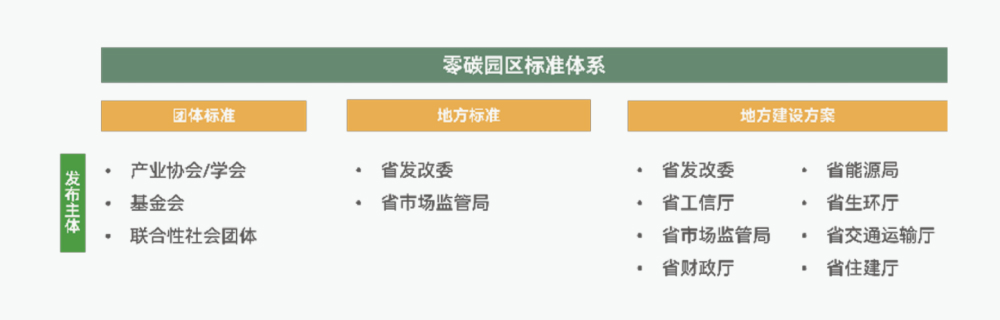
Since the announcement of China's "Dual Carbon" goals in 2020, technical standards for zero-carbon industrial parks have emerged along three different pathways:
◆ Voluntary industry association-led "group standards" spearheaded by bodies like the China Energy Conservation Association and the China Association for Engineering Construction Standardization;
◆ Local government standards tailored to local resource endowments and industrial characteristics; and
◆ Local implementation plans with integrated governance mechanisms to bridge high-level national policy and ground-level operational needs. While this divergent set of standards facilitated early experimentation, it also led to challenges such as inconsistent carbon accounting methodologies, a lack of unified third-party verification protocols, and difficulties in benchmarking performance across parks. These inconsistencies undermined the credibility of carbon reductions, raised compliance costs for businesses, and obstructed the development of scalable financial instruments based on park-level carbon assets. This underscored the need for unified and consistent national standards, setting the stage for the enhanced policy guidance contained in the "Notice on Carrying out Zero-Carbon Park Construction" of July 2025.
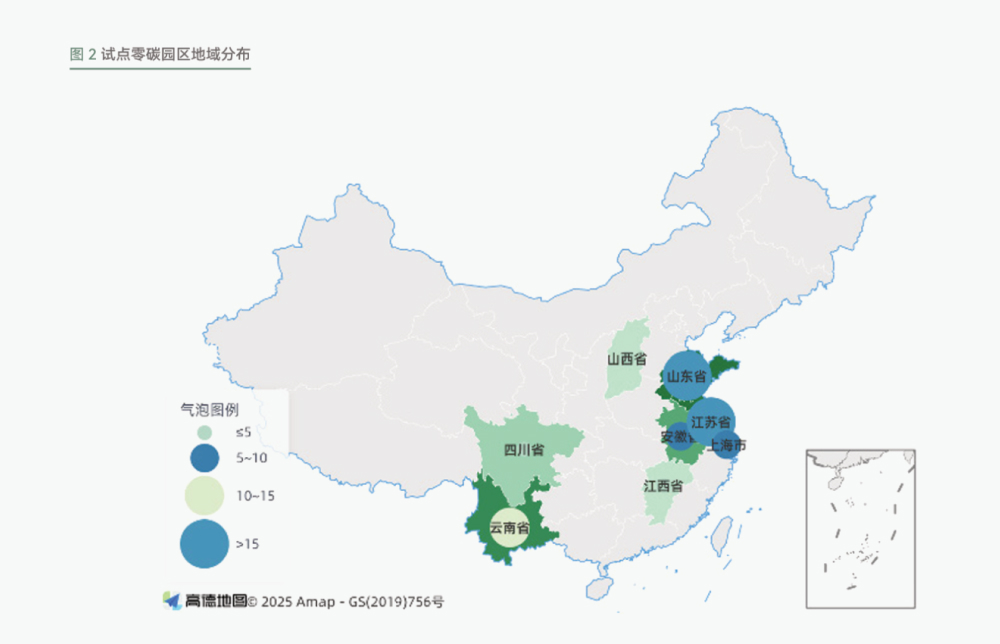
Analysis of 80 pilot parks across eight provinces reveals three regional models:
◆ Eastern coastal regions have developed emerging-industry-driven parks that leverage advanced manufacturing and digital industries;
◆ The Southwest has developed clean-energy-driven parks that capitalize on the region’s abundant solar, wind, and hydropower to form competitive green supply chains; and
◆ Central provinces have developed energy-transition-driven parks where decarbonizing traditional manufacturing and coal-based systems has unlocked new growth.
Despite varied pathways, the three distinct regional types all converge on integration of renewable energy systems, electrification, and industrial upgrading with a strategic focus on new energy1 and new materials2 sectors.
A hallmark of current progress is the shift from single-dimension projects, where a zero-carbon industrial park focuses on one isolated area of decarbonization and consequently fails to capture the larger efficiency and emission-reduction gains from integrated system design, toward more holistic, multi-dimensional system-wide approaches. This includes the development of renewables-centered energy systems ("source grid-load-storage"), green and circular industrial value chains, electrified and digitalized mobility, low-carbon buildings, ecological restoration, and the establishment of carbon accounting and management systems. However, varying levels of maturity across different dimensions indicate the transition remains in a phase of optimization and scaling.
The adoption of a unified national policy framework—defining goals, pathways, governance, and accounting methods—under the 2025 "Notice on Carrying out Zero-Carbon Park Construction" signaled a new stage. This was punctuated by the National Development and Reform Commission’s announcement of 52 national-level zero-carbon parks. As China’s zero-carbon industrial parks transition from locally driven pilots to nationally coordinated deployment, future efforts should focus on:
Elevating association standards to industry and national standards, and establishing a tiered carbon accounting and certification system to ensure comparability and enforceability.
Coordinating energy, industry, transport, buildings, and resource circularity pathways to shift from isolated projects to unified system-level optimization.
Expanding trading mechanisms for carbon allowances, green power certificates, and voluntary credits, supported by emissions-linked financial products to reinforce market incentives for emissions reductions. Success on these goals will help zero-carbon parks evolve from demonstration projects into a foundational engine for China’s green industrialization and global low-carbon competitiveness.

Address
6-2-62, Jianguomenwai Diplomatic Residence Compound, 1 Xiushui Street, Chaoyang District, Beijing, 100600 P.R. China
igdpoffice@igdp.cn
86-10-8532-3096
86-10-8532 2632
© 2026 Institute for Global Decarbonization Progress (iGDP)